Home Cold-Plunge Water Care Kit: Circulation & Clean Water
Seven pieces for looking after the water in a home cold plunge – a pump, a filter, test strips, a floating lid, a thermometer and two optional add-ons.
Published October 6, 2026 · 7 picks
At a glance
7 picksAs an Amazon Associate I earn from qualifying purchases. If you buy through a link on this page we may earn a small commission – the price is the same for you. How this works.
01
FREESEA 800GPH Small Pond Pump, 45W Submersible
A small pond pump on the tub floor keeps the water moving and pushes it through the rest of the loop.
Water that never moves never passes a filter. This FREESEA is a small side-suction pond pump, about 4 in (10 cm) long, that sits on the tub floor on four suction cups and pushes water up a hose and out over the rim. The listing gives 800 GPH (3,028 L/h) from 45 W, an adjustable flow and a maximum lift of 10 ft (3 m) – headroom for a filter cartridge in the line.
It is built for ponds and fountains, and the listing says nothing about running in water with a person in it. Treat it as equipment that works between plunges: on a GFCI-protected outlet, unplugged before you get in. The maker lists dry-run and overheat protection; do not lean on it, and unplug the pump before the water drops below its intake. The same pump empties the tub when the water is due for a change.
Tip: Use the 3/4 in nozzle and 3/4 in tubing for the whole loop – one hose size means fewer adapters and fewer joints that can drip.
02
Plunge Crafters Cold Plunge Water Filter System, 10" Housing, 3/4" NPT Ports, 2x50 Micron
A 10-inch housing with a pleated cartridge strains hair, grit and debris out of the water on every pass.
Most folding tubs come without a filter, so whatever comes off skin and feet stays in the water until the next change. This kit from Plunge Crafters puts a 10 in housing with a pleated 50-micron cartridge into the hose between the pump and the tub. It has 3/4 in NPT ports and ships with two hose barbs, two clamps, a mounting bracket and the wrench that opens the housing.
It is a housing and two cartridges, not a complete system: the pump and the tubing are separate, and the maker’s build guide is a download. The listing is clear that the hose barbs are for low-pressure plunge or spa loops, not for household water pressure. The maker suggests a fresh cartridge every month with daily use.
Tip: Write the date on each new cartridge with a marker – “monthly” is easy to lose track of.
03
JNW Direct Pool Test Strips for Pools and Spas - 7 in 1 Water Test 100 Pack
A seven-pad strip shows in half a minute what clear water hides – sanitizer, pH and alkalinity.
Clear water and balanced water are not the same thing, and the eye only sees the first. A strip shows the second: dip it for two seconds, wait thirty and hold it against the chart on the bottle. This one reads seven values in one go – free and total chlorine, bromine, pH, total alkalinity, total hardness and cyanuric acid.
Strips are a guide, not a lab test. Colors are compared by eye and the listing gives no accuracy figure, which is enough to notice a pH that has wandered or a sanitizer reading that has dropped to nothing. The maker says to use an opened bottle within 90 days, so expect to replace it before it is empty.
Tip: Take a strip out with dry fingers and close the cap right away – the maker’s own advice is to keep the strips away from moisture and light.
04
The Pod Company Insulated Ice Pod Lid – Floating Thermal Cover for Standard Ice Pod
An insulated lid that floats on the water keeps leaves, dust and daylight out between plunges.
Between plunges, a cold tub’s trouble arrives from above: leaves, dust, insects and daylight. This lid from The Pod Company does not rest on the rim – it floats on the water inside the tub, and an inflatable ring around its edge is pumped up until it touches the wall all the way round. The listing gives 4 mm (0.16 in) of insulation and a weight of 1.7 lb (0.79 kg).
The catch is the fit. It is made for the maker’s own standard Ice Pod, and the listing states no diameter. If your tub is a different brand, measure the inside width at the waterline and ask the seller before you order. Whatever the tub, a floating lid is a cover for the water, not a guard for the people around it.
Tip: Stand the lid on its edge to drip dry while you plunge – laid flat on the ground it picks up the grit you are trying to keep out of the water.
05
PRASBURR Polar Bear Floating Pool Thermometer for Ice Bath with String
A battery-free analog thermometer shows when the water has warmed up and is due a closer look.
Water temperature is a water-care number as much as a comfort one: a tub that has warmed up over a sunny week is the one to test first. This PRASBURR is a plain analog thermometer, 7.5 in (19 cm) long, hanging under a float shaped like a polar bear in a swim ring. It reads in °F and °C, comes with a string and needs neither a battery nor daylight.
That last point is why it suits a covered tub. A solar thermometer needs light that a lid shuts out; this one can hang on a hook in a dim garage all week and read the same. The listing gives no accuracy figure and no lower limit, so use it to follow the trend from day to day rather than to argue over a degree.
Tip: Lower it in when the lid comes off and give it a couple of minutes before you read it – a thermometer that has been hanging in warm air needs time to come down to the water’s temperature.
06
Coralife Turbo-Twist 3X Aquarium UV Sterilizer, Up to 125 Gallons
Optional – an inline 9-watt UV unit from the aquarium world adds a last stage after the filter.
A filter catches what it can hold; what is too small for it flows straight through. A UV unit is the usual answer to that in aquariums: water runs past a lamp inside a closed black housing on its way back to the tank. The Turbo-Twist 3X is Coralife’s 9-watt model, rated for up to 125 gal (473 L). The maker describes it as removing free-floating microorganisms from aquarium water, and gives it a spiral flow path to keep the water near the lamp for longer.
In a cold plunge loop it is an add-on, not a foundation. The listing does not mention plunge tubs, gives no flow range and no hose size, and UV leaves nothing in the tub itself – only the water passing the lamp is treated. It does not replace a filter, a sanitizer or a water change. Keep it outside the tub, clear of splashes, on the same GFCI-protected plug as the pump.
Tip: Put it after the filter, never before – UV works on clear water, and anything cloudy shades the lamp.
07
GLACIER FRESH Garden Hose Filter Pre-Filter for Pool & Spa 1-Pack
Optional – a carbon filter on the garden hose treats the fill water before it reaches the tub.
Every water change starts with whatever the hose delivers. On city water that is usually fine as it comes. On a well, or through old pipes, it can mean sediment and a smell before anyone has been in the tub. This blue cartridge screws between the tap and the hose, or onto the hose end, and passes the fill through coconut-shell activated carbon. The maker says it reduces sediment, chlorine and odors and rates it for up to 8,000 gal (30,283 L).
The chlorine part cuts both ways. Less chlorine means less smell, and it also means the tub starts without the small dose of sanitizer that city water carries. The NSF mark on the label is a materials certification, and the listing gives no micron rating, so treat it as a first rough pass rather than a guarantee.
Tip: Let the water run through it for 30 seconds before you point the hose into the tub, as the listing advises.
The first week of a home cold plunge is about nerve. Every week after that is about water. A tub that is filled and left alone turns cloudy, then slick along the walls, and the standard cure – drain it, wipe it, fill it again – means moving a hundred gallons each time.
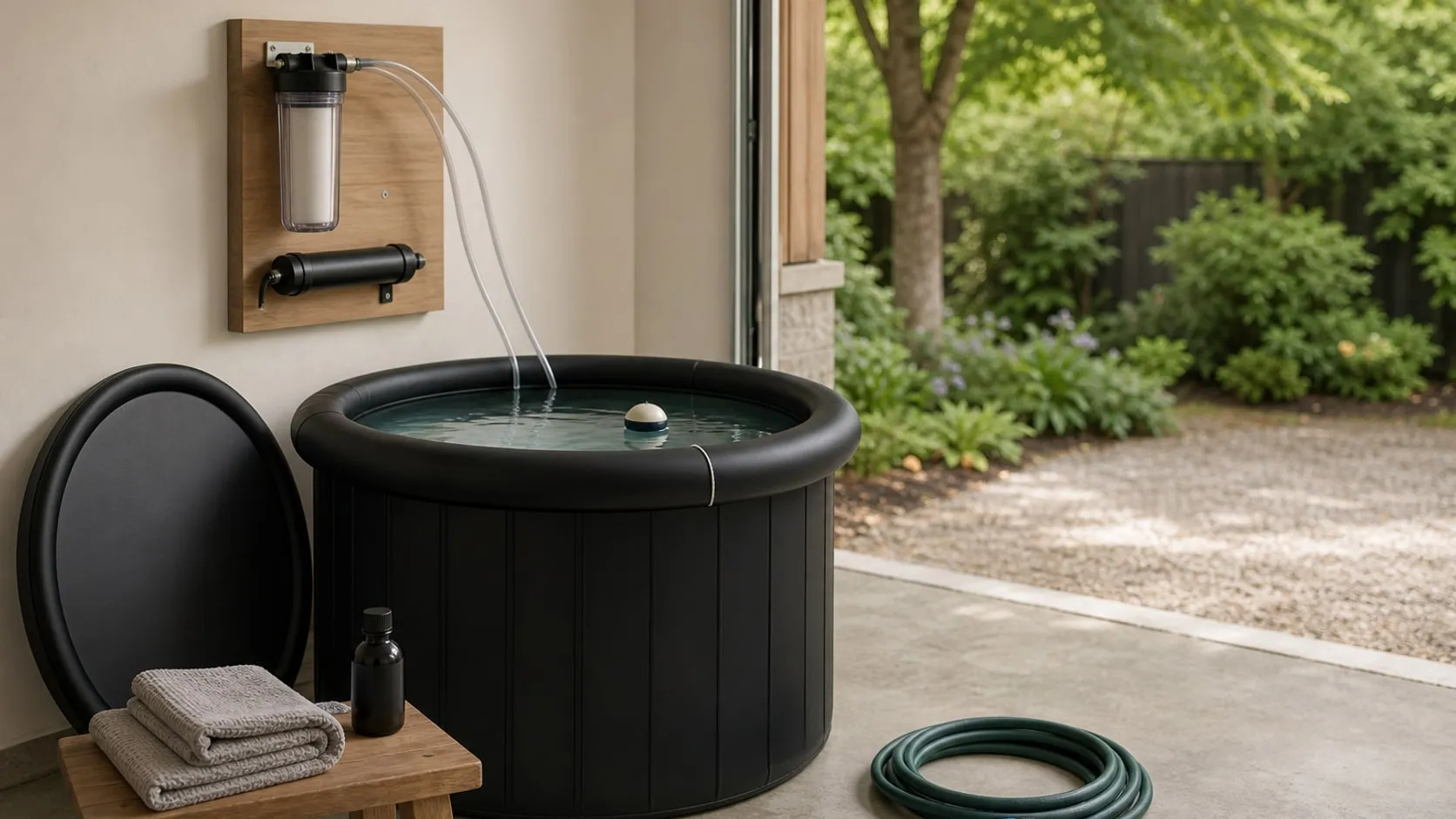
This kit is the modest alternative. A pump and a filter make a loop that runs between plunges. Test strips and a thermometer tell you what the water is doing, and a lid keeps out what would otherwise fall in. Two more pieces, a UV unit and a hose filter, are add-ons for particular cases. None of it needs plumbing, and none of it replaces a water change – the aim is fewer of them, not none.
How the loop goes together
The hardware here was matched by the listings’ numbers, not sold as a set. Check each connection against the manuals before you cut any tubing.
- Order. Pump on the tub floor, hose up and over the rim, filter housing, UV unit if you use one, hose back over the rim into the water.
- Tubing. It is not in any of the boxes. The pump’s largest nozzle and the filter’s hose barbs are both 3/4 in, so tubing with a 3/4 in inside diameter fits both. The UV unit’s listing gives no hose size.
- Filter. Outside the tub, on its bracket, where a drip does no harm and the cartridge is easy to see.
- With a chiller. Put the filter ahead of it, so the chiller gets strained water, and let the chiller’s own flow range decide how far the pump is turned down.
- First start. Run the pump and watch every joint for a few minutes. A slow drip at a clamp is easier to fix now than to find in the morning.
- Running time. Between plunges only. The plug comes out before you get in.
What each piece does – and when to skip it
- Pump. The piece everything else hangs on. Skip it – and the filter and UV unit with it – only if you would rather empty and refill the tub often than look after the water.
- Filter. It belongs with the pump; neither does much alone. If your tub or chiller has a filter built in, you already own this piece.
- Test strips. Keep them if anything but plain water goes into the tub. The bottle prints pool and spa targets – pH 7.2 to 7.8, total alkalinity 80 to 120 ppm. Where your tub’s manual gives its own numbers, the manual wins.
- Lid. Only if it fits: this one is made for a single maker’s tub, and its listing states no diameter. If your tub came with its own lid, that lid, used every time, does the main job.
- Thermometer. Skip it if you already own one. Any thermometer that reads the tub’s water will do.
- UV unit. The first thing to leave out. It adds a stage to a routine that already works; it cannot stand in for one.
- Hose filter. Skip it on city water that runs clear and without a strong smell. Keep it for a well, for old pipes, or for fill water that arrives with visible sediment.
A simple rhythm
- Every plunge. Rinse off first – what you do not carry in, the filter does not have to carry out. Unplug the loop, lift the lid. Afterwards: lid on, dry hands, plug back in.
- Twice a week. Dip a strip, which is the rate the strip maker suggests for pools and hot tubs, and read the thermometer while you are there. A tub that has warmed up deserves the closer look.
- Every week. Look at the cartridge and wipe the waterline with a clean cloth.
- Every month. A fresh cartridge if you plunge daily, per the filter’s maker.
- Water change. At the interval your tub’s maker gives, and sooner if the water turns cloudy, starts to smell or the walls feel slick. Wipe the tub and rinse the pump and hoses before you refill.
There is no sanitizer in this kit, on purpose. Whether a tub takes chlorine, bromine, something else or nothing at all is for its maker to say, and the same goes for a chiller. Read both manuals first, dose by the product’s label, and let the strips show you what is left in the water.
Safety: the pump and the UV unit are pond and aquarium equipment, and neither listing mentions water with a person in it. Plug them into a GFCI-protected outlet, keep plugs and the UV unit off the ground and out of splash range, and pull the plug before you get in. Do not open the UV unit while it is plugged in – UV light harms eyes and skin. Never mix water-care chemicals, and store them out of children’s reach. A floating lid is not a safety barrier: where children or pets can reach the tub, drain it. And the usual rule for the plunge itself holds – never alone, and if you are pregnant or have a heart condition, talk to your doctor first.