Compact Recovery Travel Kit For Busy Athletes
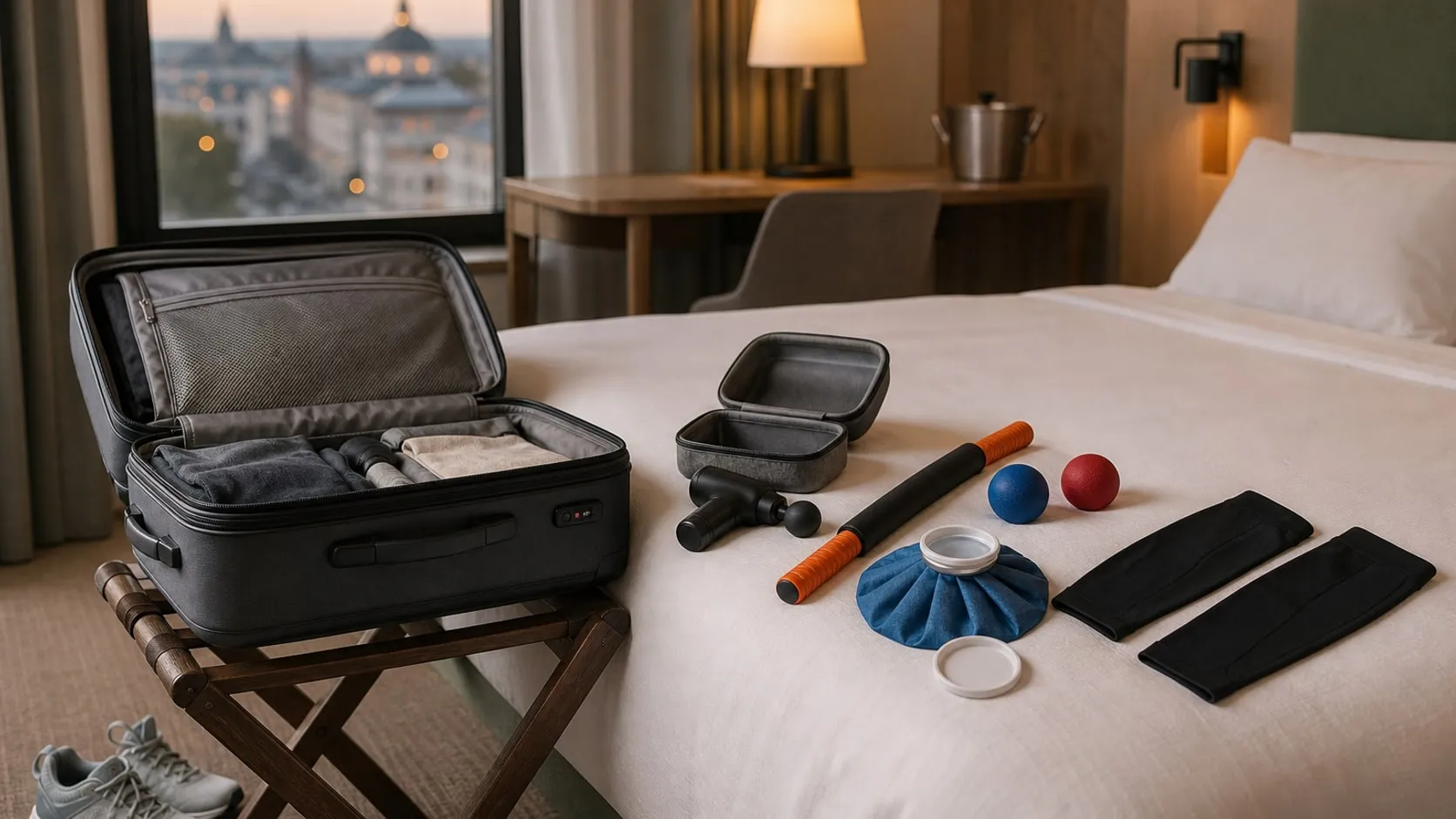
A carry-on recovery kit for athletes on the move – mini massage gun, stick roller, massage balls, ice bag and calf sleeves – plus a 20-minute hotel-room routine.
Published October 7, 2026 · 5 picks
Training plans rarely survive a week of travel in one piece, and the cool-down is usually the first thing to go. The foam roller stays at home, the gel pack has no freezer to go into, and the hotel floor is nowhere you want to lie down. Compact tools – mini massage guns, stick rollers, massage balls – are regulars in recovery roundups for exactly that reason. The five below travel in a carry-on, and the routine built around them takes about 20 minutes in a hotel room, a locker room or an office with the door closed.
Many athletes use a routine like this to wind down after a session and to draw a line under a travel day. It is a comfort ritual, not a treatment: pain that is sharp, sits on one side or is still there the next morning is a question for a doctor or physical therapist. One caution belongs to travel in particular: a calf that is swollen, warm, red or painful – especially on one side, after a long flight or drive – is not something to massage, roll or compress. Get medical help promptly.
Pack the kit
- Size. The longest piece is the stick at 17.75 in (45 cm), so it decides which bag the kit travels in. It lies along the long edge of a typical 22 in (56 cm) carry-on; measure your backpack before you count on it.
- Weight. Gun, stick and balls together come to roughly 2 lb (about 1 kg) by the listing figures. The ice bag and the sleeves are fabric and fold flat.
- Security. Nothing in the kit is a liquid, gel or cream, and the ice bag travels empty. The massage gun has a built-in lithium battery: keep it in your carry-on and check your airline’s battery rules before you fly – the listing does not give the battery’s capacity.
- Power. One USB-C cable. A full charge takes 3.5 hours per the spec table, so plug the gun in the night before you leave.
- Small stuff. The two balls ride inside a shoe, and the sleeves roll up beside them.
Step 1 · Percussion
Start with the big muscles while they are still warm from the session. The BOB AND BRAD Q2 Mini weighs 0.95 lb (0.43 kg) and measures 5.75 in (14.6 cm) in its longest dimension. The maker gives up to 3000 RPM and a noise level under 45 dB – worth knowing when there is a neighbor on the other side of the wall.
- Sit on the edge of the bed or on a chair, and start on the lowest setting.
- Rest the head on the muscle and glide slowly over thighs and glutes: front of the thigh, back of the thigh, glute – about 30 seconds each, then the other side.
- Keep the head moving and let the device do the tapping. Pressing harder is not the point.
- Three minutes covers both legs.
Safety: percussion belongs on muscle. Stay off bone and joints – kneecap, hip bone, spine – and away from the neck and head, and leave out any spot that is bruised, swollen or possibly injured. If something hurts, tingles or goes numb, stop. Ask your doctor first if you are pregnant, take blood thinners or have ever had a blood clot. The Q2 Mini is listed as not water resistant: dry hands, and keep it away from the sink and the ice.
Step 2 · Roll the calves
A stick does what a foam roller does without the floor. The Tiger Tail 18in Massage Stick is a black foam roller surface between two orange grips, 17.75 in (45 cm) long and 11.2 oz (318 g), and the maker describes it as firm and non-flexible – the pressure you put in with your arms is the pressure the muscle gets.
- Sit down and put one foot up on a chair or the bed frame, knee bent, calf relaxed.
- Hold a grip in each hand, set the stick across the back of the calf and roll slowly from above the ankle to below the knee, 10 to 15 passes.
- Move to the outside of the lower leg – the muscle beside the shin, not the shin itself – for a few passes more.
- About a minute per leg. Add the outside of the thigh if there is time.
Safety: roll muscle, not bone. Stay off the shin bone, the kneecap and the hollow at the back of the knee. Mild discomfort is normal; sharp pain is the signal to ease off or stop.
Step 3 · Press the small spots
Some spots are too small for a gun or a stick: the arch of the foot, the side of the hip. That is the job of a ball. The Kieba massage balls are two solid rubber balls, each 2.5 in (6.4 cm) across, in what the listing calls official lacrosse-ball size and weight. Both are firm, so where you use them decides how strong it feels.
- Feet. Sit down, put one ball under the arch of a bare foot and roll slowly from heel to ball of the foot for 30 to 60 seconds. Sitting keeps the pressure light.
- Hips and glutes. Stand with your back to a wall, place a ball between the wall and the fleshy part of one glute and lean in. Small, slow circles, about 30 seconds a side. How far you lean sets the pressure.
- Two to three minutes for both feet and both sides.
Safety: a ball puts your weight on one small point. Keep it on muscle – not on the spine, not on bone, not on the neck – and choose the wall over the floor until you know how it feels. Ease off at any tingling, numbness or sharp pain. A ball under a standing foot can roll away: sit, or hold on to something solid.
Step 4 · Ice, feet up
The cold step comes after the pressure tools, not before: chilled skin is a poor judge of how hard you are pressing. A gel pack needs a freezer, and many hotel rooms do not have one. The MUELLER ice bag only needs the ice machine down the hall – a 9 in (22.8 cm) fabric bag with a TPU liner and a screw-top lid that travels empty.
- Fill it about two-thirds with ice, as the listing says, and screw the lid on straight and tight.
- Lie down, prop your feet on a pillow and set the bag on the spot that worked hardest – a knee, an ankle, a calf. Many athletes ice after a long session simply because cold feels good on warm legs.
- Up to 10 minutes, then take it off.
- Pour the meltwater into the sink and leave the bag open to air-dry before it goes back in the suitcase.
Safety: if the cold stings, put a thin layer of cloth – a pillowcase, a T-shirt – between the bag and your skin. Keep it to 10 to 15 minutes on one spot, let the skin warm up completely before you repeat, and do not fall asleep with ice on. If you have reduced feeling in the area, diabetes, a circulation problem or Raynaud’s, ask your doctor before you use ice.
No ice machine? A cool shower on the legs for a minute is a fair stand-in.
Step 5 · Sleeves on
Dry your legs and wait until the iced spot feels warm again. Then pull on the sleeves. The Rymora calf sleeves are a footless pull-on pair in a 54% nylon, 39% polyester, 7% elastane knit, and the maker describes the compression as graduated. Many runners keep calf sleeves on for an hour or two after a session simply because they like the snug, held feeling.
- Measure before you order. The listing has eight sizes, keeps its size chart in the product images and says not to guess.
- Sleeves on, feet up for a few more minutes if the schedule allows – or sleeves on and out the door.
- They are machine washable; on a longer trip a rinse in the sink and a night over the towel rail does the job.
Safety: sleeves should feel snug, never painful. Take them off if your feet tingle, go numb or feel cold, and do not sleep in them unless a doctor has told you to. If you have diabetes or a circulation problem, ask your doctor before using compression. Whether to wear compression on a long flight, and which kind, is also a question for your doctor – a footless sleeve is not a flight sock.
Run the routine
- Percussion – 3 minutes, thighs and glutes.
- Stick – 2 to 3 minutes, calves.
- Balls – 2 to 3 minutes, feet and hips.
- Ice – up to 10 minutes, feet up.
- Sleeves – on, for as long as they feel good.
That is about 20 minutes, and half of it is lying down. There is no prize for doing every step, for pressing harder or for icing longer.
The two-minute version
Not every day has 20 minutes in it. For commuters and back-to-back meeting days, one tool is still a routine:
- At a desk: shoes off, a ball under one foot, a minute per side.
- In the locker room: the stick over each calf, a minute per leg, sitting on the bench.
- On the couch at night: the massage gun on its lowest setting over the thighs, then feet up.
Repack
Wipe the stick, the balls and the head of the massage gun with a dry cloth. Let the ice bag dry with its lid off, wash the sleeves and plug the gun into its USB-C cable. Then everything goes back into the same corner of the bag – so the kit is packed before the next trip is planned.
At a glance
5 picks- 01 Amazon
Step 1 · Percussion
BOB AND BRAD Q2 Mini Massage Gun, Pocket-Sized, Small, Travel Essential (Classic Black) - 02 Amazon
Step 2 · Roll the calves
Tiger Tail 18in Massage Stick Portable Roller, Handheld, The Original 18 (Orange/Black) - 03 Amazon
Step 3 · Press the small spots
Kieba Massage Lacrosse Balls for Myofascial Release, Set of 2 Firm Balls (Blue and Red) - 04 Amazon
Step 4 · Ice, feet up
MUELLER Sports Medicine Reusable Ice Pack, 9" Bag, Cold Bag (Blue) - 05 Amazon
Step 5 · Sleeves on
Rymora Calf Compression Sleeves for Men & Women – Sports, Running (Black, 1 Pair)
As an Amazon Associate I earn from qualifying purchases. If you buy through a link on this page we may earn a small commission – the price is the same for you. How this works.
01
BOB AND BRAD Q2 Mini Massage Gun, Pocket-Sized, Small, Travel Essential (Classic Black)
Under a pound and charged over USB-C, it covers the big leg muscles without adding a second charger to the bag.
A mini massage gun is the travel version of the full-size tool: the same tapping motion in a body the maker calls pocket-sized. The Q2 Mini – designed, the listing says, by physical therapists Bob and Brad – weighs 0.95 lb (0.43 kg) and measures 5.75 in (14.6 cm) in its longest dimension. The maker gives up to 3000 RPM, up to 35 lb of stall force and a noise level under 45 dB. It charges over USB-C from a standard 5 V / 2 A adapter, so it shares a cable with most phones and laptops.
For travel, the gaps in the listing matter more than usual. Battery capacity and run time are not stated, a full charge takes 3.5 hours per the spec table, and the text never says how many speed levels there are. The product photo shows five heads and a zip case, but the listing does not spell out what is in the box. It is also listed as not water resistant.
Tip: Charge it the night before you leave and pack it in your carry-on – airlines set their own rules for lithium batteries, so check your airline’s page before you fly.
02
Tiger Tail 18in Massage Stick Portable Roller, Handheld, The Original 18 (Orange/Black)
A rigid 17.75 in stick is used sitting on the edge of the bed, so the hotel carpet stays out of the routine.
A massage stick is a foam roller turned inside out: instead of lying on it, you hold it by two grips and roll it over the muscle. That makes it a natural travel tool – it works sitting on the edge of a bed or standing in a locker room, with no floor involved. The Tiger Tail is 17.75 in (45 cm) long and weighs 11.2 oz (318 g), with a black foam roller surface between two orange ribbed grips. The maker describes the design as firm and non-flexible and the foam as latex-free and made in the US.
The trade-off is pressure: it comes from your arms, not from your body weight, and some areas are awkward to reach alone. The length is the other thing to check – 17.75 in fits a carry-on or a backpack, not a handbag. The same listing has an 11 in version for smaller bags.
Tip: Roll muscle, not bone – stay off the shin, the kneecap and the back of the knee, and keep each pass slow.
03
Kieba Massage Lacrosse Balls for Myofascial Release, Set of 2 Firm Balls (Blue and Red)
Two firm 2.5 in rubber balls reach the arches and hips that a gun and a stick slide past.
A massage ball does the detail work: it presses on one small spot where a roller or a stick spreads the pressure out. This set is two solid rubber balls, one blue and one red, each 2.5 in (6.4 cm) across – the listing says official lacrosse-ball size and weight. You lean on the ball against a wall, a chair or the floor and let your own weight set the pressure. The maker says the rubber has no chemical odor and will not stain walls.
Both balls are firm, so there is no gentler one to start with; a wall instead of the floor is the way to soften things. No pouch is listed, and a loose ball rolls – inside a shoe is a sensible place for the pair to travel.
Tip: Keep the ball on muscle – not on the spine, not on bone – and start seated or against a wall before you put your full weight on it.
04
MUELLER Sports Medicine Reusable Ice Pack, 9" Bag, Cold Bag (Blue)
A screw-top bag travels empty and fills at the hotel ice machine – no freezer required.
Gel packs are the usual cold step at home, but they need a freezer – and many hotel rooms do not have one. An ice bag turns that around: it travels empty and is filled where the ice is. Mueller’s is a 9 in (22.8 cm) blue fabric bag with a TPU liner and a white screw-top lid. The listing says to fill it two-thirds with ice, close the lid, and afterward drain it and let it air-dry. The maker says the fabric wicks moisture and turns darker as it does.
There is no strap, so the bag is held in place by a hand, a towel or simply by lying still, and at 9 in it covers one knee or ankle at a time. The listing gives no usable figure for weight or capacity.
Tip: Leave the lid off until the bag is completely dry before you pack it – and check that the lid is screwed on straight before you lie down on hotel bedding.
05
Rymora Calf Compression Sleeves for Men & Women – Sports, Running (Black, 1 Pair)
Footless pull-on sleeves in eight sizes give the snug finish many runners like once the tools are packed away.
Calf sleeves are the part of the kit you wear instead of use: a snug tube from ankle to knee that goes on when the tools go back in the bag. Rymora’s come as a pair in a 54% nylon, 39% polyester, 7% elastane knit, footless and pull-on, and the maker describes the compression as graduated and the fabric as moisture-wicking. Black alone is listed in eight sizes, from X-Small to 4X-Large – a finer spread than sleeves sold in three combined size ranges.
The listing does not give a compression level in mmHg, and it is firm about sizing: measure, do not guess, and use the chart in the product images. Because the sleeves stop at the ankle, they are not a substitute for a full compression sock.
Tip: Pull them on over dry skin once any iced spot has warmed up again, and take them off if your feet tingle or feel cold.