Before/After: Build A Desk-To-Evening Recovery Nook
A stiff desk-day ending becomes a 35-minute corner routine – heat wrap, long roller, massage gun, compression boots and a gel pack – with the gear behind each change.
Published October 7, 2026 · 5 picks
Massage guns, compression boots and the rest of the compact recovery shelf have had a very good year, and the people buying them are increasingly not athletes but remote and hybrid workers who want twenty quiet minutes between the last call and dinner. The gear is the easy part. The hard part is that most of it ends up in a closet, in its case, and a massage gun in a case is a massage gun nobody uses.
This guide takes one corner of a home from “before” – a chair, a closed laptop and a stiff neck – to “after”: a strip of rug, a basket and a routine that takes about 35 minutes and happens because the things it needs are in the open. Five objects cause the change, and each one is a step.
One note before you start: this is a comfort ritual for the ordinary stiffness of sitting, not a treatment. Pain that is sharp, sits on one side, follows an injury or is still there in the morning is a question for a doctor or physical therapist, not for a massage gun or a pair of boots.
Before: six o’clock, same chair
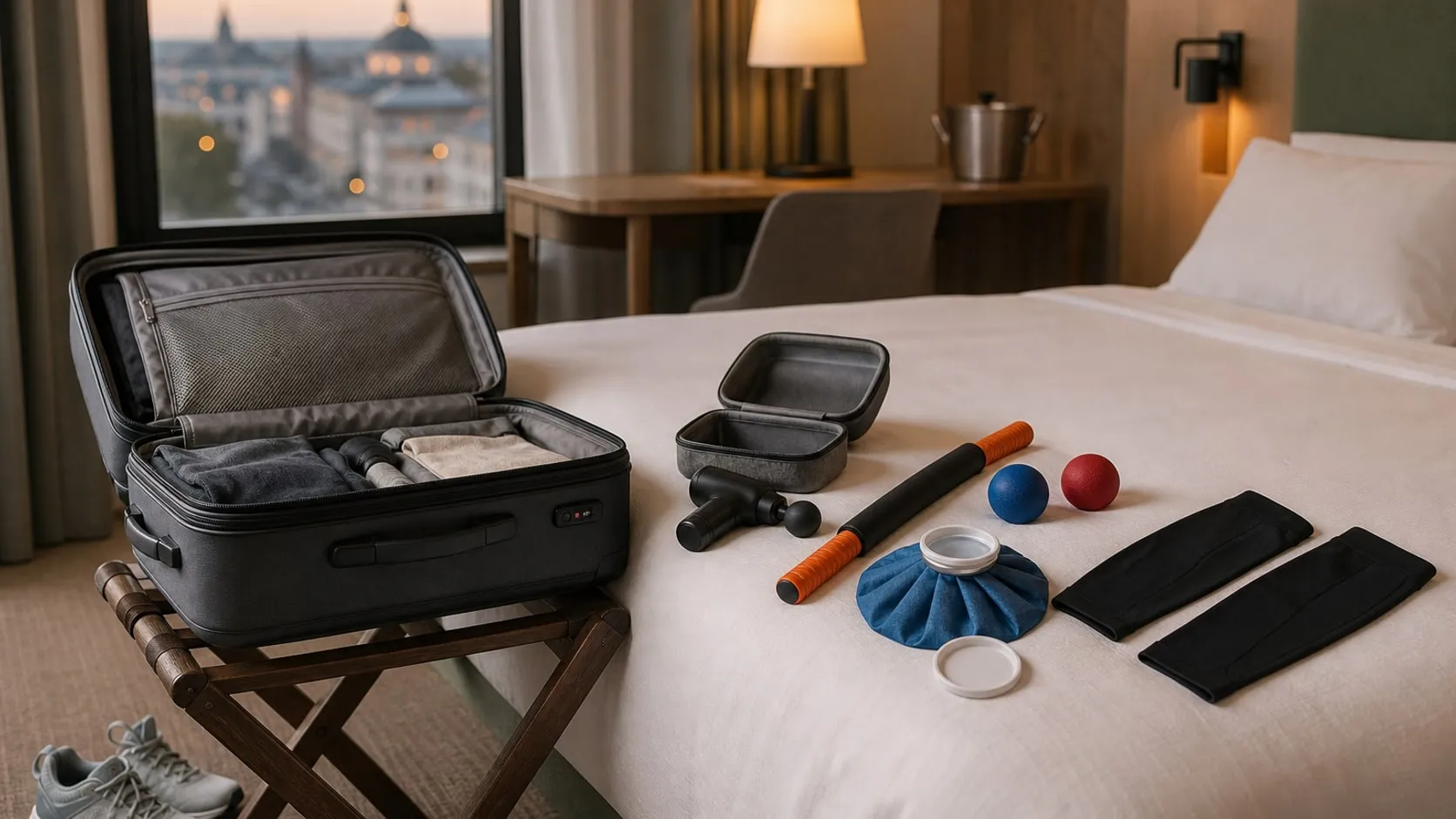
Walk into the “before” at the end of a desk day. The laptop closes and nothing else changes. You are still in the same chair, your shoulders are up around your ears after eight hours of screen, your neck turns one way more easily than the other, and your hips feel like they have been folded. Your calves are heavy from being still. There is a massage gun somewhere – a gift, in its case, in the hall closet – and a tennis ball in a desk drawer that has been there since you read about it. The evening starts on the couch, in the same shape you sat in all day, and the line between work and not-work never quite gets drawn.
Nothing here is wrong with the gear. The corner does not exist yet, so the routine has nowhere to happen. Here is what changes, and in what order.
The change: give the kit a corner
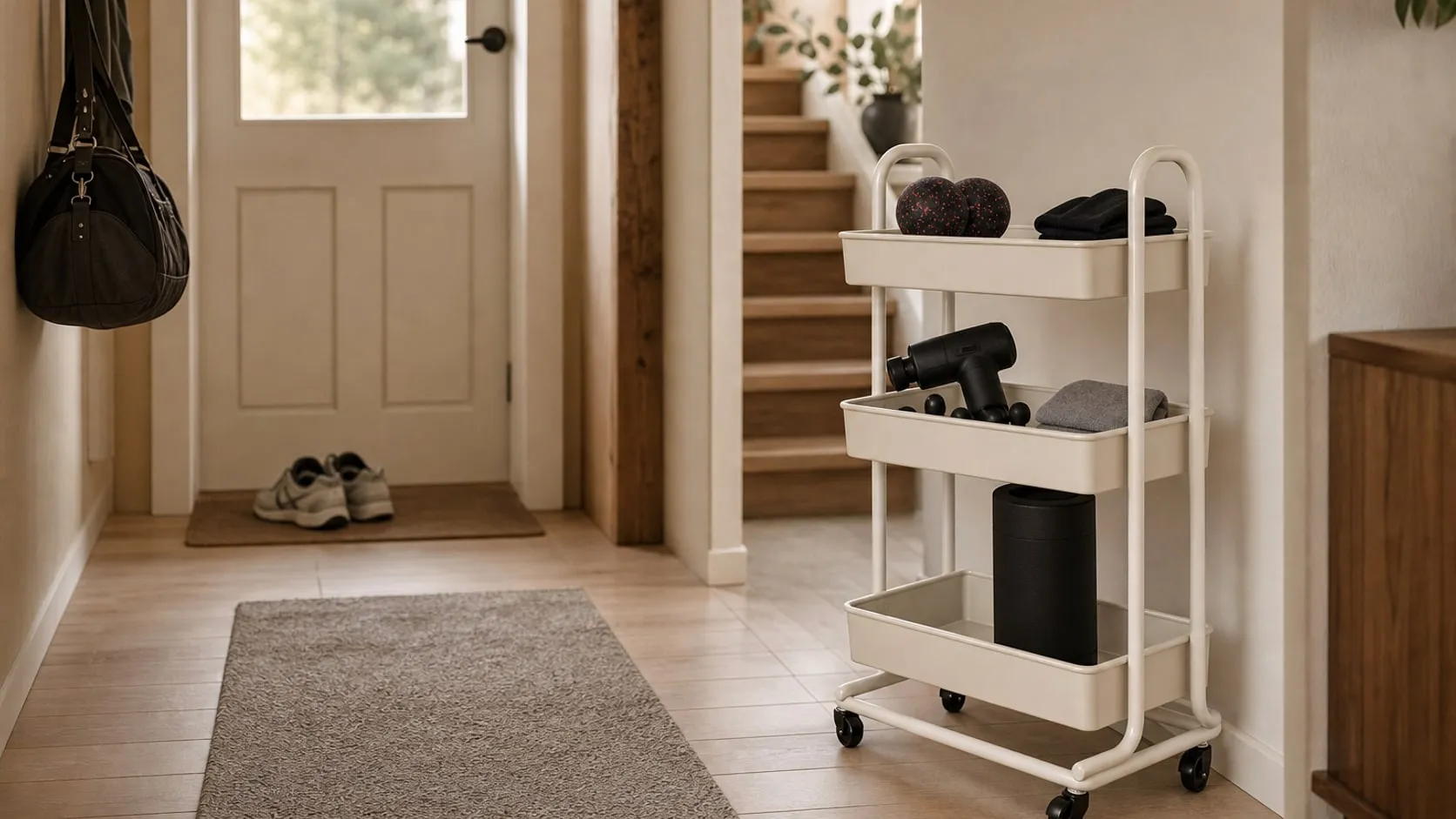
Before the first step, pick the spot. It needs three things: a strip of clear floor about 6 by 3 ft (1.8 by 0.9 m) – the 36 in roller decides that; a chair, armchair or the end of a couch within reach of an outlet, for the boots; and somewhere open to keep the kit – a basket on the floor, a low shelf, a tray under the window. Open is the rule. The gun lives in the basket with its case unzipped, the roller leans in the corner, the wrap hangs over the arm of the chair, and the packs live in the freezer door. Gear you can see at six o’clock is gear you use at six o’clock.
A corner by a window works best, because the routine starts while there is still daylight and ends after it has gone, and that change in the light is half of what makes it feel like the day has ended.
Step 1 · Heat on the neck before anything else
Before: shoulders up by the ears, a neck that turns one way, and a laptop that closed two minutes ago.
The first change is the simplest: warmth on the neck before you do anything with your hands. The REVIX microwavable wrap is a plush collar filled with flaxseed and herbs and cut for exactly this – a high collar around the neck, a panel down the upper back and wings that reach 19.6 in (50 cm) across the shoulders, per the maker – and its own weight holds it in place with no strap and no cord. It goes in the microwave while you shut the laptop, and it is on your shoulders by the time you reach the chair.
The listing does not give a microwave time, so the tag in the box is the authority. Heat it in short bursts, shake the filling between them, and test it on the inside of a wrist before it goes on your neck. Then sit, let the shoulders drop, and give it five minutes before you go to the floor. It comes off for the roller and goes back on for Steps 3 and 4, where you are sitting again.
- Warm it at the start of the routine, not the end: the point is to arrive at the floor with a neck that has already let go.
- Keep the laptop closed. The wrap is the signal that the desk day is over.
- Afterward it goes back over the arm of the chair, where it airs out and where you will see it tomorrow.
After: the shoulders are down, the neck turns both ways, and the day has a line drawn under it.
Safety: a grain-filled wrap can scorch or even catch fire if it is overheated, so never leave the microwave unattended, never heat it longer than the tag says, and let it cool fully before it is put away. If you have reduced feeling in the neck or shoulders, diabetes or a skin condition, ask your doctor before using heat, and keep it off broken or irritated skin.
Step 2 · Unfold the upper back
Before: a chest that has been curling toward a screen since nine, and a mid-back that has forgotten how to arch.
A short roller cannot do this step. The Amazon Basics 36 in roller can, because at 36 in (91 cm) it supports the head and the tailbone at the same time: you lie along it, knees bent, feet flat, and let your arms fall open to the sides. Gravity does the rest – the chest opens, the shoulders drop back toward the floor, and the mid-back, rounded all day, gets a few minutes of the opposite. It is 6 in (15 cm) across, molded from firm polypropylene foam with smooth, rounded edges, and it wipes clean.
Two or three minutes lying still is the main event. Then turn across it for the rolling part: upper back on the roller, hands behind your head, feet flat, and roll slowly from the bottom of the shoulder blades to the top of the shoulders and back, pausing where it feels tight. Finish with the front and outside of the thighs if there is time. Five minutes in all.
- Lie along it first, roll second. The lying-still part is the one people skip, and it is the one a desk day needs most.
- Firm means firm. A folded towel over the roller takes the edge off for the first week.
- Roll the mid-back and the thighs; stay off the lower back and the neck.
After: you stand up an inch taller than you lay down, and the roller leans back in its corner.
Safety: mild discomfort is normal, sharp pain is not – come off it. Keep the roller off the lower back, the neck and any joint, and if you have osteoporosis, a spine condition or a recent injury, ask your doctor before rolling at all.
Step 3 · Percussion where the chair lands
Before: hips that feel folded, glutes that have been a cushion since morning, and calves heavy from eight hours of being still.
This is where the gun comes out of the closet and into the basket. The Mebak 3 is a full-size percussion gun with five speeds from 950 to 3000 RPM, a 12 mm stroke and 53 lb of stall force per the maker, seven heads and a zip case – and the one feature that matters at the end of a tiring day: an LED pressure indicator on the back of the barrel that shows how hard you are leaning on it. The maker gives 1.68 lb (0.76 kg) for the gun and 39 to 50 dB in use, quiet enough for an apartment at seven in the evening.
Put the wrap back on, sit on the front edge of the chair with the big round head fitted and the lowest speed set. Glutes first, then the outside of the hip, then the calves with the foot up on the roller – about a minute per area, each side, keeping the head gliding and the pressure light. Five minutes covers all of it.
- Lowest speed, biggest head, and let the gun do the work. The indicator should stay low; if it climbs, so are you.
- Keep it moving. Parking it on one spot is not more effective, only more sore.
- The case stays open in the basket with the cable beside it, so the next session starts charged.
After: the hips unfold, the calves feel like calves again, and the gun has a home where you can see it.
Safety: a massage gun is for muscle only. Keep it off bones and joints – the hip bone, the kneecap, the shin – and away from the neck, the head and the front of the throat, and never use it on a bruise, a swelling or a suspected injury. Stop if anything hurts, tingles or goes numb. If you are pregnant, take blood thinners or have had a blood clot, ask your doctor first. The Mebak 3 is listed as not water resistant: dry hands, and it stays well away from the gel packs.
Step 4 · Boots on, book open
Before: the evening starts on the couch in the same shape you sat in all day, and the heaviness in the legs stays until bedtime.
The boots are the piece that turns the end of the routine into something you look forward to, because they are the only step where you do nothing. The QUINEAR Leg Recovery System is a pair of zip-on full-leg sleeves with four air chambers each – foot, lower calf, upper calf, thigh – that inflate one after another from the foot up and then release. There are eight pressure levels that the maker gives as 50 to 120 mmHg, three programs, and a timer of 20, 25 or 30 minutes after which it switches itself off. A built-in pressure sensor, per the maker, adjusts to the size of the leg.
Sit in the chair by the outlet, zip in, set the lowest level and the 20-minute timer, and open a book. The right setting feels like a slow, firm hug that starts at the foot and travels up; it should never feel like a squeeze. The wrap from Step 1 stays on your shoulders if it is still warm. This is the sit-still half of the evening, and that is the point.
- Lowest level and 20 minutes the first few times. Turn it up next week, not tonight.
- Legs out straight on an ottoman or a second chair – the boots are long, and the hoses need room.
- It is corded: the chair stays where the outlet is.
After: twenty minutes have passed, the book has moved on twenty pages, and the legs feel lighter when the boots come off.
Safety: compression is not for everyone. If you have ever had a blood clot or deep vein thrombosis, have a circulation problem, heart failure, diabetes with nerve damage, a recent injury or surgery to the leg, an infection or swelling in the leg, or are pregnant, talk to your doctor before using compression boots. Never use them over a wound, a rash or a suspected injury, and unzip at once if anything hurts, tingles or goes numb. A calf that is swollen, warm, red or painful – especially on one side – is not something to compress; it needs medical attention promptly.
Step 5 · One pack for the spot that asked
Before: a knee that complained on the stairs, or a low back that is still the shape of the chair, and a bag of frozen peas standing in for both.
The last change is the smallest: a proper pack in the freezer door, and a way to hold it on without using a hand. The MEDVICE hot and cold packs are two 10 × 5 in (25 × 13 cm) gel packs, 0.5 in (1.3 cm) thick, that the maker says go in either the freezer or the microwave, plus an elastic strap – 36 in (91 cm), 40 in (102 cm) stretched – that holds a pack against a knee or the small of the back. With two packs, one lives cold in the freezer and the other can be warm when you want it.
Use it while the boots run, when your hands are already busy with a book: cold on the knee that complained, or warm on the low back. Then put it back where it came from, so it is ready tomorrow.
- A thin cloth – a dish towel, a T-shirt – always goes between the pack and skin, warm or cold.
- 10 to 15 minutes on one spot is plenty. Take it off and let the skin come back to normal before any second round.
- The microwave and freezer times are printed on the pack itself, not on the listing. Read the panel the first time.
After: the spot that asked for attention got it, and nobody had to hold a bag of peas.
Safety: cold and heat both damage skin that is left under them too long – keep sessions short, keep the cloth layer, and never fall asleep with a pack on. If you have reduced feeling in the area, diabetes, a circulation problem or Raynaud’s, ask your doctor before using cold or heat. Test a warmed pack on the inside of a wrist before it goes on, and do not microwave one whose shell is split or leaking.
After: the same corner, a different evening
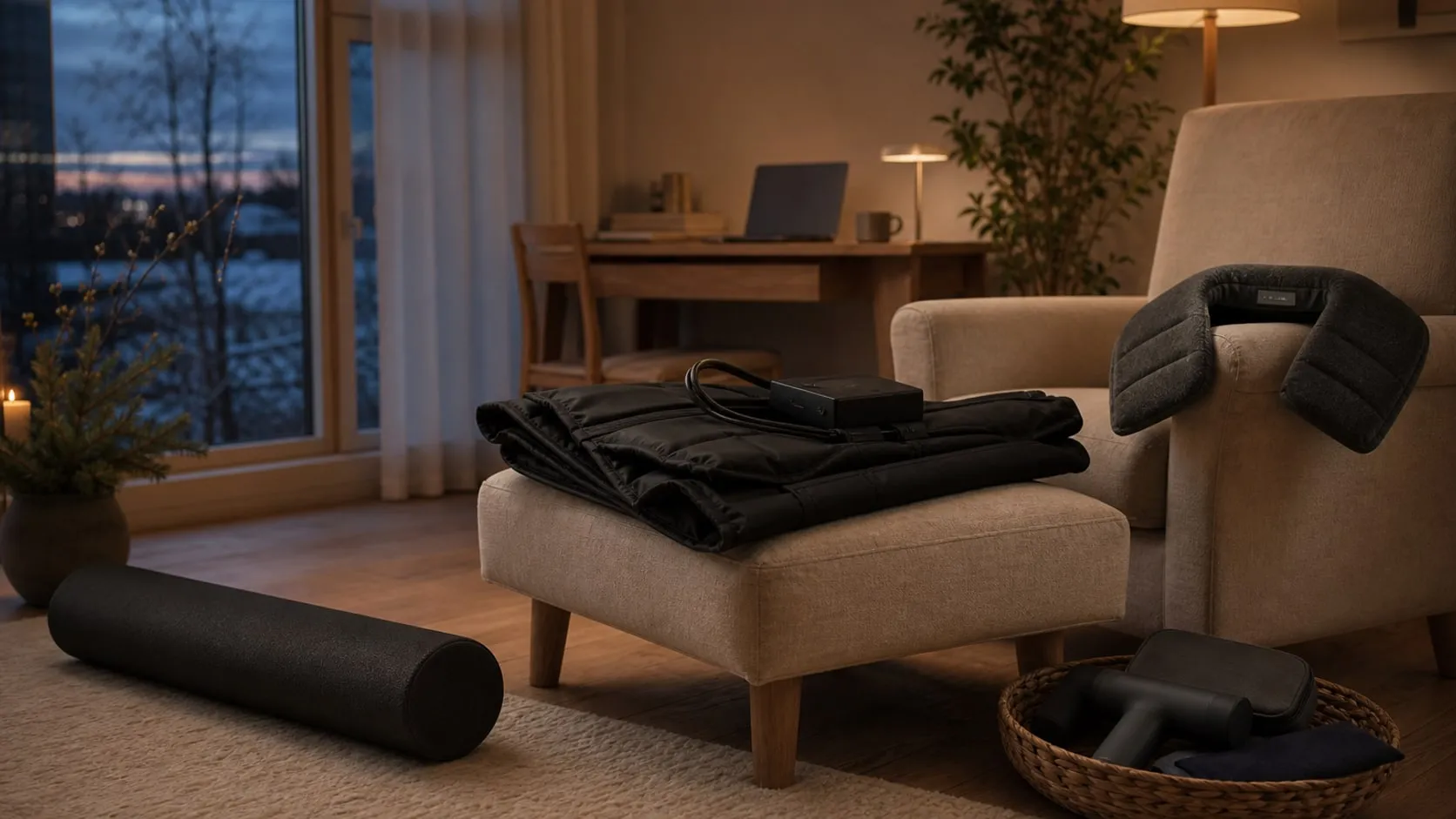
Walk into the “after” corner at six. A strip of pale rug by the window with a black roller lying along it. An armchair with a dark gray wrap over one arm and a basket beside it, the gun in its open case, the boots folded on the ottoman with their controller on top. The laptop is closed on the desk behind, and nobody is sitting at it.
The routine takes about 35 minutes:
- Wrap on – 5 minutes, sitting, shoulders down.
- Roller – 5 minutes, lying along it, then rolling the upper back.
- Gun – 5 minutes, glutes, hips and calves, wrap back on.
- Boots – 20 minutes with a book, a pack strapped on the knee or the low back.
The last of the daylight goes while the boots run, and by the time they release, the desk day is something that happened earlier. Short on time? Wrap on, boots on, book open is still a routine. There is no prize for doing every step, for pressing harder or for turning the boots up.
Nothing about the chair, the room or the job has changed. What has changed is that the kit is in the open, the corner is the corner, and the line between work and evening gets drawn every day in the same spot.
Safety: this routine is for the stiffness of ordinary sitting. If you have a heart condition, high blood pressure, a circulation disorder, a history of blood clots, or are pregnant, talk to your doctor before building a routine around heat, cold, percussion or compression – and skip any step your doctor or your body says no to.
Keeping the “after”
- Hang the wrap over the arm of the chair to air; never put it away warm, and spot-clean only – a grain filling cannot be machine washed.
- Wipe the roller and the gun’s head with a dry cloth; the gun goes back in its open case with the cable beside it.
- Unzip the boots and let them air before they are folded; wipe the inside with a dry cloth and coil the hoses loosely.
- The cold pack goes back in the freezer door; a warmed pack cools on the counter before it is put away. Check the shells for splits now and then.
- Keep the corner clear. The day a laundry basket moves in is the day the routine stops.
At a glance
5 picks- 01 Amazon
Step 1 · Heat on the neck before anything else
REVIX Neck Heating Pad Microwavable, Weighted Heat Wrap for Neck Shoulders (Dark Gray) - 02 Amazon
Step 2 · Unfold the upper back
Amazon Basics High-Density Foam Roller for Exercise, Stretching and Muscle Recovery, 36 Inches, Black - 03 Amazon
Step 3 · Percussion where the chair lands
Mebak 3 Massage Gun Deep Tissue, Muscle Massager for Athletes Pain Relief (Dark Gray) - 04 Amazon
Step 4 · Boots on, book open
QUINEAR Leg Recovery Compression System for Athlete Post Workout, Professional Sequential Device for Massage Therapy, Foot and Leg Recovery Boots (Medium) - 05 Amazon
Step 5 · One pack for the spot that asked
MEDVICE Reusable Hot and Cold Ice Packs for Injuries (3-Piece Set), Joint Pain
As an Amazon Associate I earn from qualifying purchases. If you buy through a link on this page we may earn a small commission – the price is the same for you. How this works.
01
REVIX Neck Heating Pad Microwavable, Weighted Heat Wrap for Neck Shoulders (Dark Gray)
A flaxseed-and-herb collar that comes out of the microwave warm and holds itself on the shoulders – the first thing that happens after the laptop closes.
A microwavable wrap is the low-tech version of the heated neck pad: a cloth collar full of flaxseed and herbs that you warm in the microwave and drape over the shoulders, where its own weight keeps it in place. The REVIX wrap is cut for the job – a high collar around the neck (3.7 in / 9.4 cm, per the maker), a panel down the upper back (7.7 in / 19.6 cm) and wings that reach 19.6 in (50 cm) across the shoulders – with a soft minky cover. The same wrap goes in the freezer for cold use, and the herbs give off a faint scent while it is warm.
What the listing does not say is how long to microwave it, how long to freeze it or how to clean it; the tag in the box has to answer those. A grain filling cannot be machine washed, the scent is not for everyone, and the only weight given is the shipping weight of about 2.9 lb (1.3 kg).
Tip: Heat it in short bursts and shake the filling between them, then test it on the inside of a wrist before it goes on your neck – if it is too hot for a wrist, it is too hot for a neck.
02
Amazon Basics High-Density Foam Roller for Exercise, Stretching and Muscle Recovery, 36 Inches, Black
A 36 in roller supports head and tailbone at once, so you can lie along it and let a screen-shaped chest open.
A full-length roller does one thing a short one cannot: it supports the whole spine at once, so you can lie along it and let the chest open after a day of leaning toward a screen. The Amazon Basics roller is 36 in (91 cm) long and 6 in (15 cm) across, molded from firm polypropylene foam with smooth, rounded edges, and the maker says it keeps its shape. It is plain – no ridges or knobs – which is exactly what you want under your spine, and it wipes clean.
Firm is the point and also the catch: a first session on the mid-back can feel hard, and a folded towel over the roller is the usual fix. The listing gives no weight limit, and its item weight of 4.32 oz is clearly wrong, so take the packed weight of about 1.2 lb (0.55 kg) as the real one.
Tip: Lie along it with your head and tailbone both supported, knees bent, arms out to the sides, and just breathe for two or three minutes before you roll anything.
03
Mebak 3 Massage Gun Deep Tissue, Muscle Massager for Athletes Pain Relief (Dark Gray)
Five speeds from 950 RPM, seven heads and a pressure indicator on the back – out of the closet and into a basket by the chair.
A full-size massage gun is the piece of the kit that works on the muscles a chair loads most: the glutes, the outside of the hips, the calves. The Mebak 3 has five speeds from 950 to 3000 RPM, a 12 mm stroke and 53 lb of stall force per the maker, seven interchangeable heads and a zip case. An LED pressure indicator on the back of the barrel shows how hard you are pressing, which is the most useful feature on an evening when you are tired enough to lean on it. The maker gives 1.68 lb (0.76 kg) for the gun and 39 to 50 dB in use.
What the listing leaves out matters for a device that lives by the couch: battery capacity and run time are not stated, a full charge takes 3 hours per the spec table, and the wall adapter is not in the box. It is listed as not water resistant – it belongs in the dry half of the routine, well away from the gel packs.
Tip: Start on the lowest speed with the big round head and keep it gliding over muscle; the pressure indicator should stay low, and the gun stays off bones, joints and the neck.
04
QUINEAR Leg Recovery Compression System for Athlete Post Workout, Professional Sequential Device for Massage Therapy, Foot and Leg Recovery Boots (Medium)
Zip-on full-leg boots with a 20-minute timer turn the end of the routine into the one step where you do nothing.
Compression boots are the recovery-room device that has moved into living rooms: a pair of zip-on sleeves with air chambers that inflate one after another from the foot toward the thigh, then let go. The QUINEAR set has four chambers per leg, eight pressure levels that the maker gives as 50 to 120 mmHg, three programs and a timer of 20, 25 or 30 minutes, after which it switches itself off. A pressure sensor, per the maker, adjusts to the size of the leg. It comes with a digital controller, zips closed over each leg and packs into its own bag at 5.5 lb (2.5 kg).
It is a corded, sit-still device, which is both the point and the limitation: the chair needs an outlet, and the 20 minutes are not going anywhere. The listing comes in three sizes but never states boot length or gives a size chart in its text, and there is no heat.
Tip: Start on the lowest level and the 20-minute timer; the right setting feels like a slow, firm hug, not a squeeze, and it is easier to turn up next week than to sit through too much tonight.
05
MEDVICE Reusable Hot and Cold Ice Packs for Injuries (3-Piece Set), Joint Pain
Two book-sized packs for the freezer or the microwave and one strap to hold either on a knee or the low back while the boots run.
A gel pack is the simplest piece of a recovery kit and the one that ends up doing the most: cold on the knee that complained on the stairs, warm on the low back after a long afternoon in a chair. The MEDVICE set is two 10 × 5 in (25 × 13 cm) packs, 0.5 in (1.3 cm) thick, that the maker says go in either the freezer or the microwave, plus one elastic strap of 36 in (91 cm) – 40 in (102 cm) stretched – that holds a pack against a knee or the small of the back so your hands are free for a book.
The listing is thin on the practical numbers: microwave and freezer times are only on the panel printed on the pack, the cover material is listed just as “fabric”, and nothing says whether the gel stays soft when frozen. At 10 × 5 in each pack covers one spot, not a whole back, and the two packs share a single strap.
Tip: A thin cloth always goes between the pack and your skin, cold or warm, and 10 to 15 minutes on one spot is plenty – let the skin come back to normal before the next round.