Basement Hot-Tub Winter-Proofing Checklist
Six things that keep a basement hot tub warm, the room dry and small problems visible through winter – from a floating blanket to a phone alert.
Published October 6, 2026 · 6 picks
At a glance
6 picksAs an Amazon Associate I earn from qualifying purchases. If you buy through a link on this page we may earn a small commission – the price is the same for you. How this works.
01
BigXwell Heavy-Duty Solar Pool Cover 7x7ft - 16Mil Blue
A bubble sheet floating on the water slows evaporation, which is where a basement tub's lost heat and damp air begin.
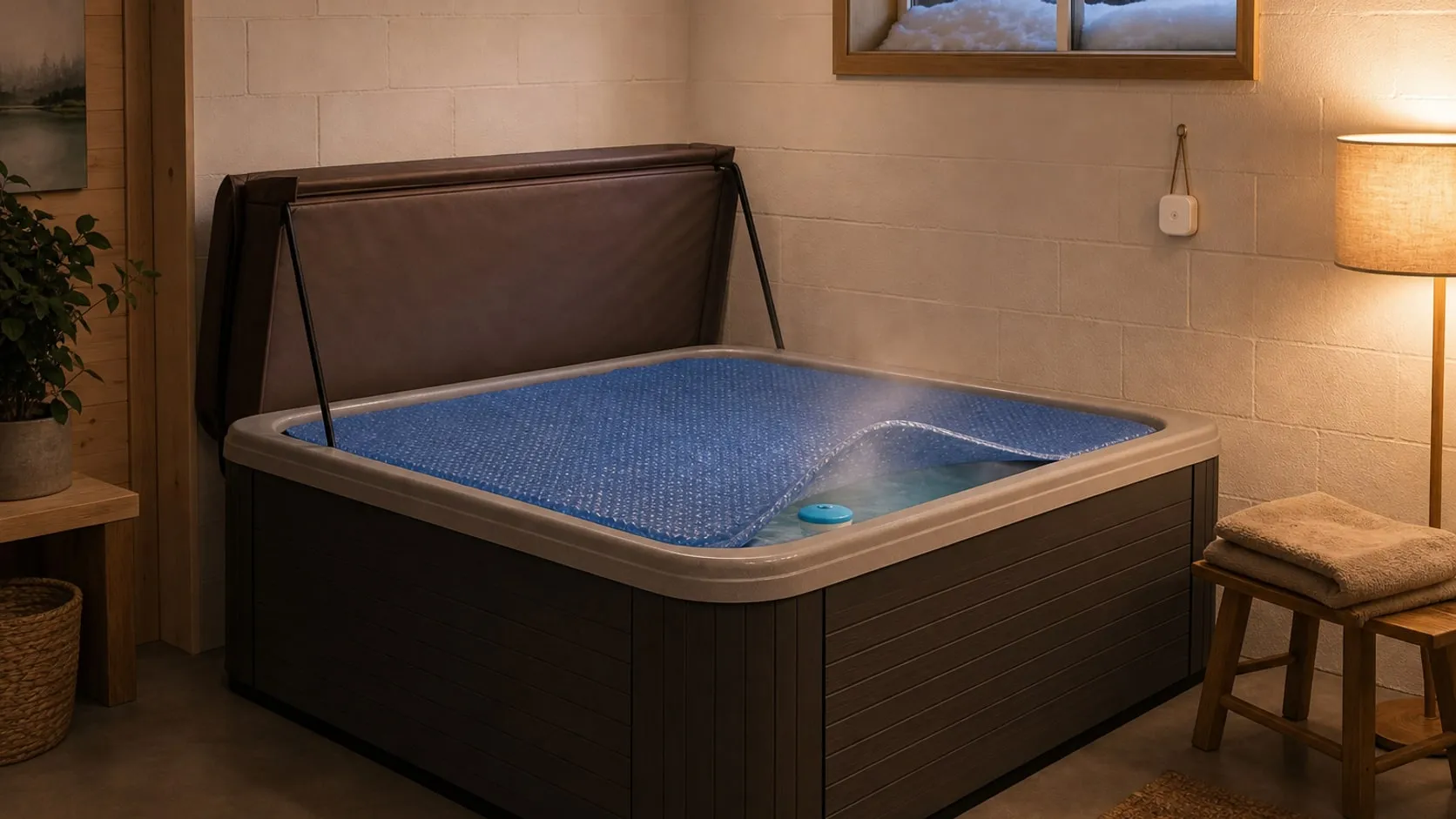
Warm water evaporates, and in a basement that vapor has nowhere to go. A floating blanket lies on the water itself, under the tub’s main cover, so less water leaves the tub in the first place. This one is a blue polyethylene bubble sheet, 16 mil thick and 7 × 7 ft (2.13 × 2.13 m), sold as a solar cover – indoors the sun plays no part, and the sheet simply works as a lid on the surface.
It is an extra layer, not a cover. The main cover still goes on top, and the sheet comes out completely before anyone gets in – never soak with it in the water. The listing makes energy claims without numbers, so expect a helper, not a fix for a worn-out cover.
Tip: Bubble sheets are usually laid bubble side down and cut with scissors. Trim a little at a time around the shell – a sheet that is slightly too big can be cut again, one that is too small cannot be fixed.
02
INTEX PureSpa Energy-Efficient Spa Cover for Inflatable Hot Tubs
A foam-lined jacket wraps the top and sidewall of a round inflatable tub in an extra layer of insulation.
An inflatable tub loses heat through every surface: the lid, the air-filled wall and the floor. This cover deals with the first two. It is a tan PVC jacket lined with high-density foam that drops over the whole tub – top and sidewall – and, in the product photo, is held by a buckled strap around the base. Intex says it can make the spa up to 50% more energy efficient; the listing gives no conditions for that figure.
It comes in one size, 78 in (198 cm) round, and the listing does not say which tub models it fits, so measure before ordering. It does nothing for the floor – on a cold slab, a mat or pad under the tub is a separate job.
Tip: Keep the control unit’s air openings clear when you fit the jacket – the heater and pump need the airflow the manual asks for.
03
Cover Caddy Cover Valet Hot Tub Spa Cover Lifter
A gas-spring lifter lets one person open and close a rigid cover, so it goes back on after every soak.
A cover only saves heat when it is on the tub. A rigid foam cover is heavy and awkward, and that is the usual reason it gets left half open after a late soak – in a basement, that means hours of warm vapor in the room. This lifter takes the excuse away: gas springs help raise the folded cover, and two arms hold it upright beside the tub until it is time to close up.
The base slides under the cabinet instead of being screwed to it. The listing is short on numbers, though: no clearance, no maximum cover size. In a basement both matter – a low ceiling, a wall or a support post can be in the cover’s path.
Tip: Before ordering, fold your cover in half, stand it on edge where it would park and swing it through the path by hand. If it clears the ceiling and the wall now, it will with the lifter.
04
NOVWANG 86 Inch Round Hot Tub Mat Absorbent Non-Slip Spa Pool Accessories
A felt mat with a waterproof backing keeps drips off the concrete and gives wet feet something to grip.
Bare concrete and wet feet are a poor match, and a basement floor in winter is slow to dry. This mat is a round sheet of gray felt, 86 in (218 cm) across and 3 mm thick, with a PE backing. Per the listing, the felt takes up splashes and drips, and the backing keeps them off the floor and grips it.
It is thin, and the listing claims no insulation, so do not expect it to warm a cold slab. Its job is the floor: less standing water, less friction under the tub and a surface that is not slick where you step out. In a room that is already damp, give the exposed felt a chance to dry between soaks.
Tip: Set the tub off-center on the mat, so the widest strip of felt is on the side where you climb out.
05
XY-WQ Puffer Floating Pool Thermometer with String, Easy-Read
A battery-free floating thermometer gives a second reading to hold against the tub's own display.
A tub’s control panel shows what the heater’s sensor reads. A separate thermometer in the water shows what the soaker will feel – and in winter it is the simplest way to notice a heater that is slowly falling behind. This one is a plain liquid-column thermometer, 8.5 in (21.6 cm) long, hanging under a blue puffer-fish float, with a scale that runs to 120 °F (50 °C).
There is nothing to charge or pair. There is also no stated accuracy and no alert, so read it as a check on the panel: if the two disagree by more than a couple of degrees, that is worth a look at the manual.
Tip: Tie the string to a cover strap or handle, and read it before you get in – after the jets have run for a minute, so the water is mixed.
06
Govee WiFi Thermometer Hygrometer H5179 with App Notification Alert
A WiFi sensor sends a phone alert when the basement air turns too damp or too cold.
Most basement tub problems build up quietly: a cover left ajar, humidity creeping up week by week, a cold snap in a room with no heat of its own. This sensor is for the days nobody goes downstairs. It measures air temperature and relative humidity, sends the readings to the Govee Home app over WiFi, and notifies your phone when either one leaves the range you set.
It has no screen and it works on 2.4 GHz WiFi only. It also depends on the router – in a power cut it goes quiet at the moment a winter basement most needs watching, so do not treat it as the only safeguard. And it measures the room, not the water.
Tip: Hang it by its lanyard at about chest height, a few steps from the tub and out of splash range. Set a humidity alert first; add a low-temperature alert if the basement is unheated.
A basement tub skips the snow and the wind, but winter still reaches it. The slab under it turns cold, the windows stay shut for months, and every lift of the cover puts warm, wet air into a room that cannot air out. Indoors, winter-proofing is less about ice and more about three things: keeping heat in the water, keeping moisture out of the room, and noticing small problems early.
The six picks follow that order. Not every one fits every tub – the foam jacket and the floor mat are for round inflatable tubs, the cover lifter for hard-shell tubs with a rigid folding cover – so take the lines that match yours.
Before the first cold snap
- Close the lid every time. An open tub feeds warm vapor into the room for as long as it stands open. Cover on, straps or clips fastened, after every soak.
- Watch the humidity. The EPA advises keeping indoor humidity below 60%, ideally between 30 and 50%. If the room sits above that, run a dehumidifier or an exhaust fan – a sensor only tells you there is a problem.
- Know your freeze protection. Many tubs have a freeze-protection mode, and it works only while the tub has power. If the basement is unheated, read that part of the manual before the first frost, and drain the tub as the manual describes if it will be switched off for long.
- Skip improvised heat. Pond and stock-tank de-icers are built for troughs and ponds, not for a tub people sit in. Keep space heaters and extension cords away from the water.
- Check the water before you get in. The CPSC’s long-standing advice is that hot tub water should not exceed 104 °F (40 °C).
Safety: the tub belongs on a GFCI-protected circuit – press the test button at the start of the season. Your tub’s manual comes first wherever it disagrees with a general list like this one.